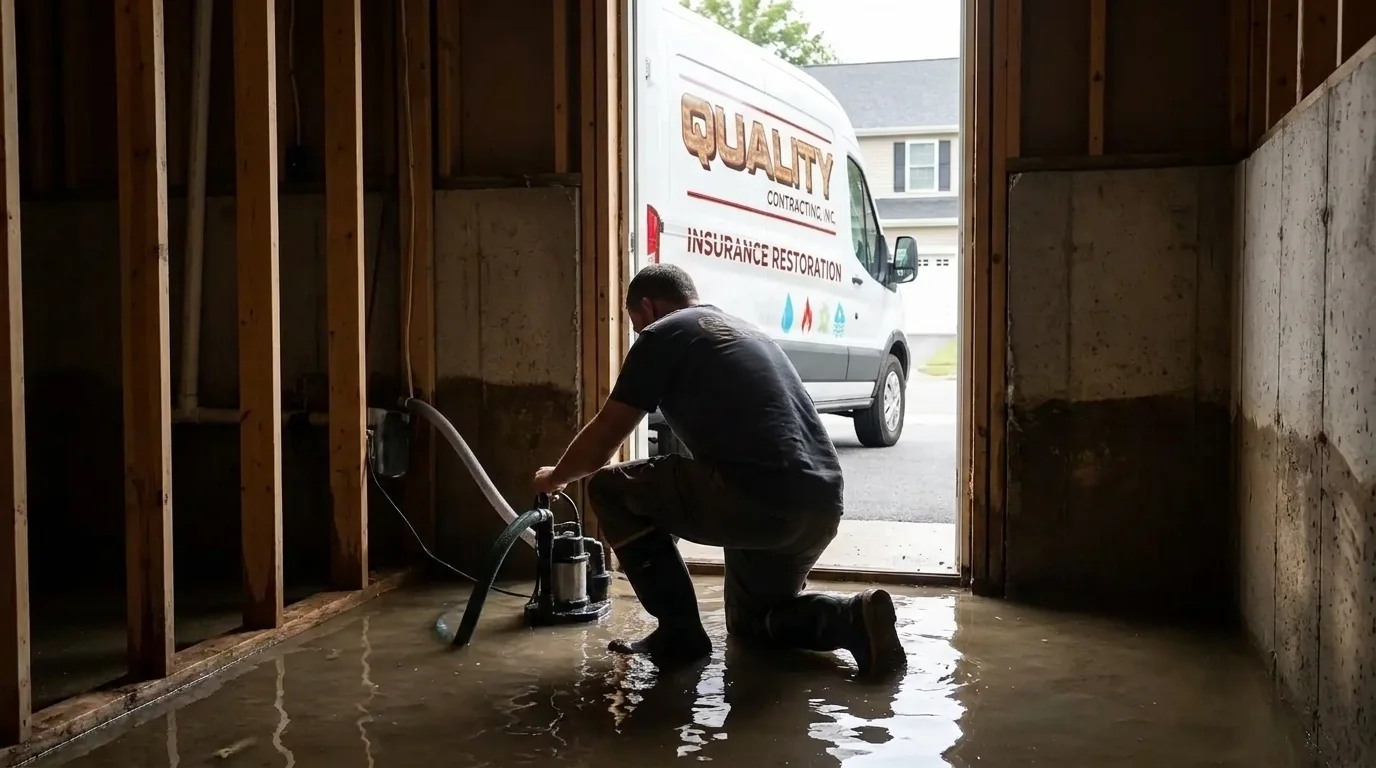
Emergency Basement Flooding Cleanup in Auburn
Emergency basement flooding cleanup in Auburn and surrounding areas. Insurance billing accepted. Call (508) 756-8800.
Water pooling in your basement? Call now for emergency service before standing water soaks into framing, insulation, and subfloor. Basement flooding is different from a burst pipe upstairs: it sits low in the home where humidity is already higher, drainage is slower, and the first 24 to 48 hours determine whether you’re dealing with a wet-vac job or a mold remediation job. If you’re hearing water under the flooring, smelling a musty basement odor, or watching a sump pump that can’t keep up, the clock is already running.
What basement flooding cleanup actually involves
Basement water damage behaves differently depending on what’s down there. A finished basement with drywall, carpet, and a finished ceiling traps moisture against framing and insulation in ways an unfinished slab never will. An unfinished basement with a sump pump failure or foundation seepage is usually faster to dry but often points to a bigger drainage or grading problem outside. Either way, the work starts with pulling standing water out fast, because concrete and masonry below grade hold moisture far longer than wood-framed walls above ground, and wicking into drywall, baseboards, and wall cavities begins almost immediately.
Equipment on a basement job typically includes submersible or truck-mounted pumps for standing water, air movers positioned to push air across wet surfaces, and low-grain-refrigerant or desiccant dehumidifiers suited to the damp, cooler conditions basements tend to hold onto. Moisture meters get used on concrete, framing, and any remaining drywall throughout the job, not just at the start, because a surface can read dry while the material behind it is still saturated.
Our process
- Extraction first. Standing water gets pumped out before anything else happens, with attention to where it’s pooling and whether it’s still rising.
- Source identification. Sump pump failure, a cracked foundation wall, window well seepage, or sewer backup all call for different next steps, so the source gets confirmed before drying begins.
- Removal of unsalvageable materials. Saturated carpet pad, baseboards, and drywall that’s wicked water past a few inches typically get cut and removed rather than dried in place, since drying them often costs more than replacement and risks trapping moisture.
- Structural drying and monitoring. Air movers and dehumidifiers run on a schedule, with moisture readings taken on framing, subfloor, and remaining wall materials until they return to a normal range, following IICRC S500 drying guidelines.
- Antimicrobial application and follow-up check. Treated surfaces get a follow-up moisture check, since basements hold ambient humidity longer than any other part of the house and a second check catches what a one-time reading misses.
What separates a good basement flooding response from a bad one
The most common mistake is drying the water that’s visible and leaving the rest. Flooring that looks dry on top can still be saturated underneath, and wet insulation behind a finished basement wall will keep feeding moisture back into the room for weeks if it’s never opened up and checked. A rushed job dries the surface, closes it up, and the homeowner is dealing with a musty smell and visible mold growth a month later.
Insurance adjusters reviewing a basement flood claim generally want to see moisture readings taken at intake and at completion, photos of removed materials before they’re disposed of, and documentation of the source of the water, since category of water (clean, gray, or contaminated) affects what’s covered and what materials can legally be dried versus removed. A written scope that separates “dried in place” from “removed and replaced” gives both the homeowner and the adjuster something concrete to work from.
What does basement flooding cleanup cost?
Costs vary widely based on how much water came in, how long it sat, whether the basement is finished, and whether the water was clean or contaminated. These are typical industry ranges, not a quote: Quality Contracting, Inc. provides a written scope of work before any cleanup begins so you know what’s included.
| Scenario | Typical range |
|---|---|
| Unfinished basement, minor seepage, clean water | $800 - $2,000 |
| Finished basement, moderate flooding, clean water | $2,500 - $6,000 |
| Full basement flood, contaminated or sewage-involved water | $6,000 - $15,000+ |
| Mold growth from basement flooding left untreated | add $1,000 - $4,000 |
| Sump pump or drainage repair alongside cleanup | $800 - $2,500 |
Homeowners insurance typically covers sudden and accidental water damage, such as a sump pump failure or burst pipe, but often excludes gradual seepage or groundwater flooding without a separate endorsement, so it’s worth checking your policy’s specific water damage language before you assume coverage.
Seasonal & regional considerations
Auburn and the surrounding Worcester County area see a predictable pattern: spring snowmelt and heavy spring rain push groundwater levels up just as sump pumps are working hardest, and older homes built on clay-heavy soil common to this part of Massachusetts drain more slowly after a storm. Power outages during heavy weather are a frequent cause of sump pump failure, since the pump itself is fine but has nothing running it. Basements with older fieldstone or block foundations, common in houses built before mid-century, are also more prone to seepage through mortar joints than newer poured concrete foundations.
Service area
Quality Contracting, Inc. responds to basement flooding throughout Auburn, MA and nearby Worcester County communities, handling everything from a single-room seepage event to a full basement flood with contaminated water.
If your basement is taking on water right now, don’t wait to see if it stops on its own. Schedule your basement water removal and let a written assessment tell you what’s actually wet before mold has a chance to start.
Services We Handle
- Basement Flood Cleanup
- Sump Pump Failure Cleanup
Frequently Asked Questions
Does homeowners insurance cover basement flooding cleanup?
How long does it take to dry out a flooded basement?
If my basement flooded, do I automatically have a mold problem?
What's the difference between clean water and contaminated water in a basement flood?
Can wet carpet or drywall in a finished basement be saved, or does it all need to come out?
Looking for the best basement-flooding-cleanup company in Auburn?
Quality Contracting, Inc. provides basement-flooding-cleanup in Auburn, MA and the surrounding area. Customers rate us 4.5 out of 5 stars across 110 Google reviews. We answer calls 24/7 — call (508) 756-8800 for immediate help.
Need basement-flooding-cleanup now?
We respond 24/7 across Auburn and surrounding MA cities.
Related Coverage
- Our Restoration Services
- Contact Quality Contracting, Inc.
- Restoration Services in Bellingham
- Restoration Services in East Douglas
- Restoration Services in Fiskdale
- Restoration Services in Framingham
- Restoration Services in Franklin Town
- Restoration Services in Hopkinton
- Restoration Services in Hudson
- Restoration Services in Leominster
- Restoration Services in Marlborough
- Restoration Services in Maynard
- Restoration Services in Milford
- Restoration Services in Natick