Industrial Restoration in Auburn
Industrial restoration in Auburn and surrounding areas. Insurance billing accepted. Call (508) 756-8800.
A burst sprinkler head in a distribution center doesn’t behave like a leak in a house. Water spreads across thousands of square feet of sealed concrete, pools under pallet racking, and wicks into insulation above the drop ceiling before anyone on the floor notices the puddle. A fire in a manufacturing bay leaves soot coating machinery, control panels, and ductwork that can’t simply be replaced like drywall. Industrial restoration deals with loss at a different scale: production downtime, equipment at risk, and a facility that often can’t shut down completely while repairs happen.
What industrial restoration actually involves
Industrial restoration covers water, fire, and smoke damage in warehouses, manufacturing plants, distribution centers, and other large commercial buildings where the loss affects building systems, inventory, and equipment, not just finishes. The scope is different from a residential job in almost every respect: moisture travels farther across open floor plans, structural steel and concrete behave differently than wood framing when wet, and electrical and mechanical systems serving production lines often need to be isolated and assessed before drying equipment can even be deployed safely.
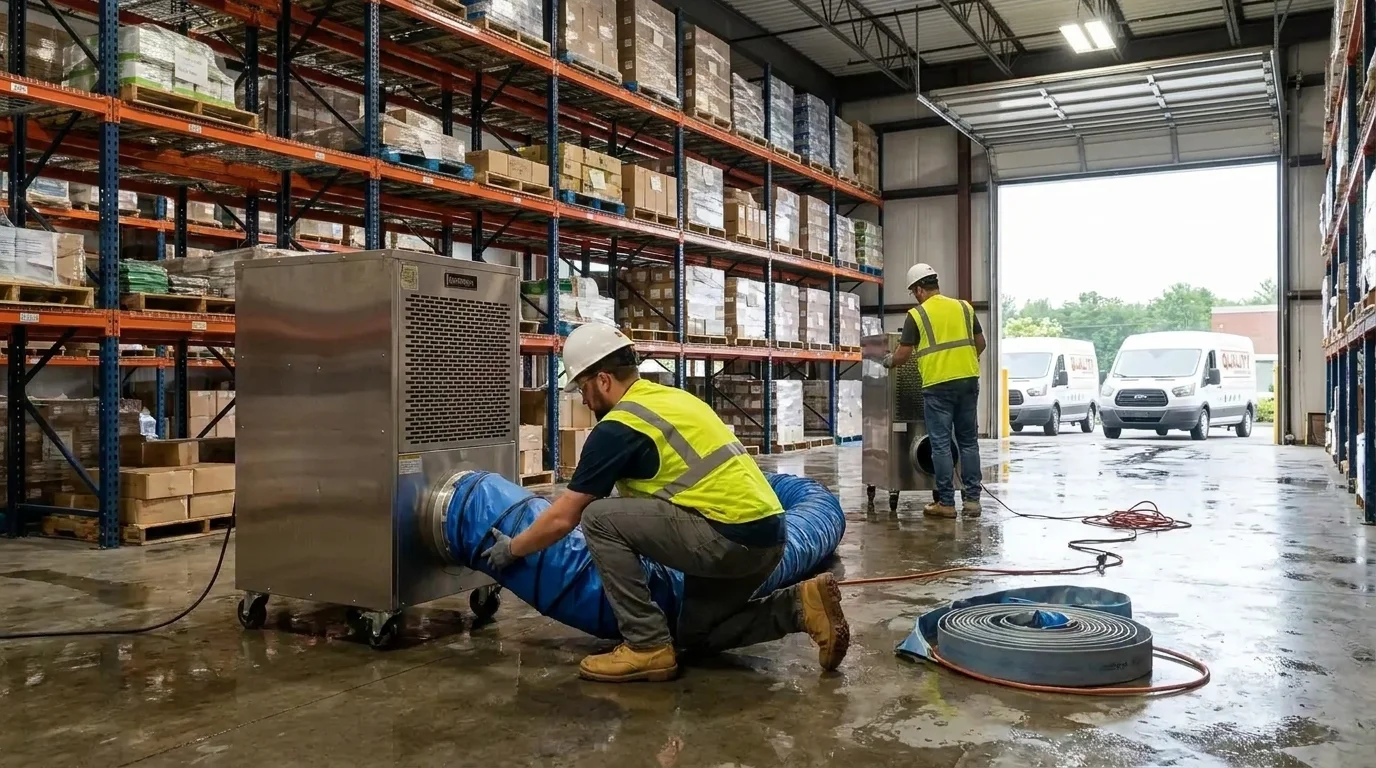
Equipment scales to match. Instead of a handful of air movers, an industrial water loss might call for desiccant dehumidifiers sized for tens of thousands of cubic feet, trench drains and submersible pumps for below-grade areas, and moisture mapping across a floor plate that takes hours just to walk. On the fire side, industrial soot often includes residue from plastics, solvents, or process chemicals stored on-site, which changes how it’s cleaned and what protective measures the crew needs before starting.
Our process
- Facility walkthrough and hazard assessment. Before any equipment comes in, we identify affected zones, flag electrical or structural hazards, and coordinate with facility management on areas that must stay operational.
- Containment and isolation. Affected sections are sealed off from active production areas using poly barriers and negative air where needed, so work doesn’t shut down parts of the building that weren’t hit.
- Extraction and structural drying. Standing water is removed from floors, pits, and below-grade areas; drying equipment is placed based on moisture readings taken across the affected footprint, not guesswork.
- Soot and residue removal (fire-related losses). Machinery, racking, ductwork, and exposed structural elements are cleaned using methods matched to the soot type, with attention to anything that could corrode or degrade if residue is left in place.
- Monitoring and documentation through dry-out. Moisture levels are checked on a schedule until the structure reads dry, with readings logged for the property’s insurance file.
What separates a good industrial restoration response from a bad one
The biggest technical miss on industrial jobs is treating a large building like a big house: throwing in extra fans and hoping volume solves a problem that’s really about airflow path and dew point control across a huge open space. Desiccant versus refrigerant dehumidification matters more here, since ambient conditions in an unconditioned warehouse can stall a drying plan that would work fine in a climate-controlled office.
Moisture hiding inside concrete, under epoxy coatings, or within insulated metal panel walls gets missed when crews only check visible surfaces. Adjusters reviewing industrial claims generally want to see moisture logs tied to specific grid locations or room numbers, photos of affected equipment before cleaning begins, and a clear line between what was damaged by the event versus pre-existing wear. Facilities with production equipment also need coordination with the building’s own maintenance or engineering staff before any cleaning touches control panels or wiring, since the wrong cleaning agent on the wrong surface can cause more damage than the original loss.
What does industrial restoration cost?
Industrial losses vary enormously based on square footage, what’s stored or manufactured on-site, and whether the damage reached equipment or just building materials. The ranges below reflect typical industry figures for different scenarios, not a quote, every facility gets a written scope of work before any work begins so there are no surprises on the invoice.
| Scenario | Typical range |
|---|---|
| Localized leak, small storage area | $2,500 - $7,000 |
| Warehouse floor water loss, no inventory damage | $8,000 - $25,000 |
| Manufacturing bay, fire/smoke with equipment exposure | $25,000 - $100,000+ |
| Large distribution center, multi-zone water intrusion | $40,000 - $150,000+ |
| Full plant fire damage with structural and equipment loss | $150,000+ |
Most commercial property policies cover sudden water and fire losses, including business interruption in many cases, but coverage for stored inventory, specialized equipment, and process downtime varies by policy. We document the loss in detail and work with your insurance carrier directly on the claim.
Seasonal & regional considerations
Auburn’s older industrial buildings often have flat or low-slope roofs that are more prone to ponding and leaks during the region’s heavy spring thaw and summer storm season. Facilities with unheated warehouse space also see pipe freeze risk in loading docks and along exterior walls during New England winters, which is a common source of sudden water loss in storage areas that don’t get regular foot traffic.
Service area
We work with manufacturing, warehouse, and distribution facilities in Auburn and throughout the surrounding Worcester County area, including the industrial corridors along Route 12 and Route 20.
If your facility has standing water, soot, or smoke damage affecting operations, get a scope of work started before downtime adds up. Call (508) 756-8800 to schedule an industrial facility assessment.
Frequently Asked Questions
Does commercial property insurance cover industrial water or fire damage?
Can part of our facility keep operating while restoration work is happening?
How is industrial soot cleanup different from a residential fire?
How do you dry a large warehouse floor compared to a single room?
What should facility management do before we arrive on-site?
Looking for the best industrial-restoration company in Auburn?
Quality Contracting, Inc. provides industrial-restoration in Auburn, MA and the surrounding area. Customers rate us 4.5 out of 5 stars across 110 Google reviews. We answer calls 24/7 — call (508) 756-8800 for immediate help.
Need industrial-restoration now?
We respond 24/7 across Auburn and surrounding MA cities.
Related Coverage
- Our Restoration Services
- Contact Quality Contracting, Inc.
- Restoration Services in Bellingham
- Restoration Services in East Douglas
- Restoration Services in Fiskdale
- Restoration Services in Framingham
- Restoration Services in Franklin Town
- Restoration Services in Hopkinton
- Restoration Services in Hudson
- Restoration Services in Leominster
- Restoration Services in Marlborough
- Restoration Services in Maynard
- Restoration Services in Milford
- Restoration Services in Natick