Mold Inspection and Testing in Auburn
Mold inspection and testing in Auburn and surrounding areas. Insurance billing accepted. Call (508) 756-8800.
A musty smell that comes and goes with the weather, a water stain on a ceiling tile that never quite dries out, a family member with unexplained allergy symptoms that ease up on vacation and come back at home. These are the moments that bring people to mold inspection and testing rather than straight to remediation. You don’t yet know if there’s a problem, how big it is, or where it’s hiding, and guessing wrong means either paying to remediate nothing or ignoring a colony that’s been spreading behind a wall for months.
What mold inspection and testing actually involves
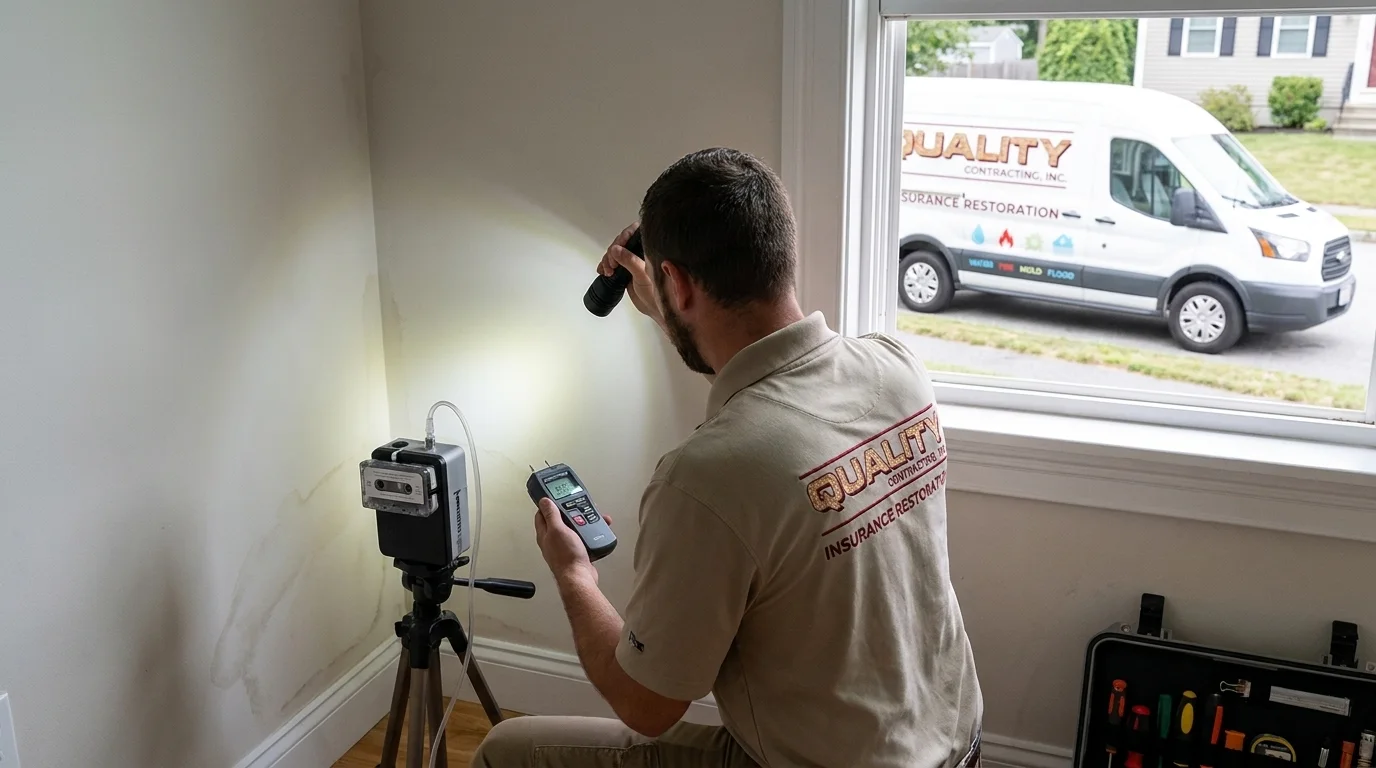
A proper mold inspection starts with a visual and moisture-driven walkthrough, not a swab kit pulled out at random. Our team uses moisture meters and thermal imaging to find damp framing, subfloor, and wall cavities that look dry on the surface but are holding water where mold actually grows. Visible growth gets documented and, where useful, sampled directly. Where there’s no visible growth but a persistent odor or health complaint, we collect air samples to compare spore counts and species indoors versus outdoors, since indoor air quality testing is really a comparison exercise, not an absolute measurement. Samples go to a third-party accredited lab, and results typically come back within a few business days. The whole on-site portion of an inspection usually runs one to two hours depending on the size of the property and how many areas need sampling.
Our process
- Intake and history - we ask about past leaks, recent renovations, musty smells, and any health symptoms tied to specific rooms, since mold almost always has a moisture story behind it.
- Moisture mapping - meters and thermal imaging identify damp materials behind walls, under flooring, and around windows, HVAC lines, and plumbing chases.
- Visual assessment and sample collection - visible growth is photographed and measured; air samples (and surface tape lifts where relevant) are collected in suspect rooms and a baseline outdoor sample for comparison.
- Lab analysis - samples are sent to an independent laboratory for spore identification and counts rather than read on-site, which keeps results objective.
- Written report and scope - you get a plain-language report showing moisture readings, sample locations, lab results, and a recommendation: no action needed, monitor, or proceed to remediation with a defined scope.
What separates a good mold inspection from a bad one
A rushed inspection relies on smell and a single swab and calls it done. A thorough one treats moisture as the root cause and traces it, because mold testing without moisture mapping just tells you mold exists somewhere, not why or whether it will come back after cleanup. Common misses include skipping the outdoor baseline sample (which makes indoor spore counts meaningless on their own), not checking crawlspaces or attic sheathing where growth is common but rarely seen, and treating every result as an automatic remediation sale rather than distinguishing between normal background levels and an active, elevated colony. Insurance adjusters reviewing a claim want to see documented moisture source, dated sample collection, chain-of-custody on lab submissions, and species-level results, not just a verbal “yes there’s mold here.”
What does mold inspection and testing cost?
Costs vary with the size of the property, the number of rooms or zones sampled, and whether air sampling, surface sampling, or both are needed. Every situation is different, and Quality Contracting, Inc. provides a written scope before any sampling or remediation work begins so there are no surprises. Homeowners insurance typically covers mold inspection when it’s tied to a covered water loss (a burst pipe, for example) but rarely covers testing for long-term humidity or condensation issues that fall under maintenance.
| Scenario | Typical range |
|---|---|
| Single-room visual inspection, no sampling | $150 - $350 |
| Visual inspection plus 2-3 air samples | $350 - $650 |
| Whole-house inspection with air and surface sampling | $600 - $1,200 |
| Post-remediation clearance testing | $300 - $600 |
| Pre-purchase home inspection add-on | $250 - $500 |
Seasonal & regional considerations
Central Massachusetts homes see real humidity swings between a muggy, still summer and a heating season that dries indoor air but often traps condensation around poorly insulated rim joists and basement walls. Older housing stock around Auburn and neighboring towns, much of it built before modern vapor barrier standards, tends to have stone or block foundations that wick moisture steadily rather than flood, which produces the slow, low-grade mold growth that’s easy to miss on a quick walkthrough. Spring thaw and late-summer humidity are the two windows we get called out most for musty-smell complaints.
Service area
We inspect and test homes and commercial properties in Auburn and throughout the surrounding Worcester County communities. If you’re outside the immediate area, call to confirm coverage for your address.
If something in your house smells off or a past leak never quite got resolved, request an air quality test before it turns into a bigger remediation job. Call (508) 756-8800 to schedule a mold inspection.
Services We Handle
- Mold Inspection
- Mold Testing
Frequently Asked Questions
Does homeowners insurance cover mold inspection and testing?
What's the difference between air sampling and surface sampling?
Do I need mold testing if I can already see visible growth?
How long does it take to get mold test results back?
Can mold inspection catch a problem that's still behind the wall?
Looking for the best mold-inspection-testing company in Auburn?
Quality Contracting, Inc. provides mold-inspection-testing in Auburn, MA and the surrounding area. Customers rate us 4.5 out of 5 stars across 110 Google reviews. We answer calls 24/7 — call (508) 756-8800 for immediate help.
Need mold-inspection-testing now?
We respond 24/7 across Auburn and surrounding MA cities.
Related Coverage
- Our Restoration Services
- Contact Quality Contracting, Inc.
- Restoration Services in Bellingham
- Restoration Services in East Douglas
- Restoration Services in Fiskdale
- Restoration Services in Framingham
- Restoration Services in Franklin Town
- Restoration Services in Hopkinton
- Restoration Services in Hudson
- Restoration Services in Leominster
- Restoration Services in Marlborough
- Restoration Services in Maynard
- Restoration Services in Milford
- Restoration Services in Natick
- How To Test for Mold in Your Home (DIY Kits vs a Pro Inspection)